Kids’ Water Bottle Checklist: 7 Things to Check Before You Buy
Choosing a water bottle for your child sounds simple. Pick a cute design, check the price, and you’re done, right?
Not always.
A good kids’ water bottle needs to handle school bags, playgrounds, accidental drops, long days, and a child who may or may not remember to close the lid properly. The wrong bottle can leak inside a school bag, become difficult for a child to use, or simply end up unused because it isn’t comfortable to carry.
Whether you’re buying a kids’ water bottle for school, a bottle for travel, or an everyday bottle for your child, there are a few things worth checking before you buy.
Here’s a simple checklist to help you choose the right one.
1. Check the Size and Capacity
Bigger isn’t always better when it comes to a kids’ water bottle.
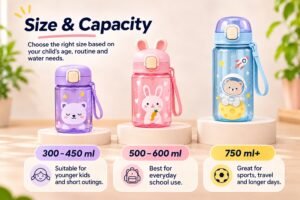
Quick guide: around 300–400ml works well for younger children and shorter outings, 450–600ml is a practical range for everyday school use, while 750ml+ makes more sense for sports, travel or longer days.
A bottle should hold enough water for your child’s day without becoming too heavy to carry. For younger children, a compact bottle is usually easier to handle. Older kids may prefer a larger capacity, especially if they spend several hours at school or participate in sports and outdoor activities.
Common capacities include:
- 300–400 ml: Suitable for younger children and shorter outings
- 450–600 ml: A practical everyday option for school
- 750 ml and above: Better suited to older children, sports, travel, or longer days
Think about your child’s age, school routine, and how much water they normally drink.
The best school water bottle for kids is one they can comfortably carry and actually use throughout the day.
2. Make Sure It Is Leak-Proof
This is probably one of the most important things to check.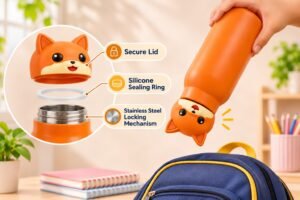
A bottle may look great in photos, but the real test comes when it gets tossed into a school bag and carried around all day.
A leak-proof water bottle for kids should have a secure lid and a reliable sealing mechanism. Pay attention to the way the lid closes. If it requires too much force or has a complicated locking system, younger children may struggle to use it themselves.
Before buying, check:
- Is the lid tightly sealed?
- Does it have a silicone or rubber sealing ring?
- Is there a locking mechanism if required?
- Can the child easily open and close it?
- Are there reviews mentioning leakage?
A few extra seconds spent checking the lid can save you from finding a soaked notebook inside your child’s bag.
3. Look at the Material
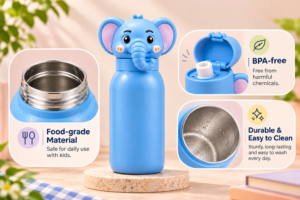
The material of the bottle affects its weight, durability, cleaning, and everyday usability.
You’ll commonly find kids’ bottles made from plastic, stainless steel, or other food-grade materials.
If you’re considering a plastic bottle, look for one made from food-grade, BPA-free materials. If you prefer a more durable option, stainless steel bottles are also popular.
The important thing is to check the manufacturer’s material information rather than choosing a bottle based only on its appearance.
For children, the bottle should also be sturdy enough to handle the occasional drop. Let’s be honest, kids aren’t exactly known for handling their belongings gently.
4. Choose a Bottle That Is Easy to Carry
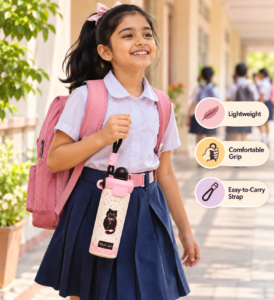
A water bottle can have all the right features, but if it’s uncomfortable to carry, your child may leave it at home.
Look for practical features such as:
- A comfortable grip
- A carry handle or loop
- A size that fits easily into a school bag
- A shape that is easy for small hands to hold
- A lightweight design
For younger children especially, usability matters more than having too many fancy features.
If your child can pick up the bottle, open it, drink from it, and close it without asking for help every time, you’ve probably found a good option.
5. Check the Drinking Spout or Lid Design
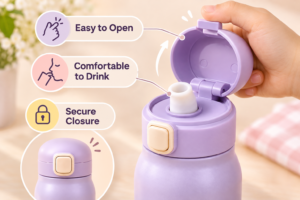
Different children prefer different drinking styles.
Some are comfortable drinking directly from a wide-mouth bottle, while others prefer a straw, flip-top, or spout.
When choosing a water bottle for kids, consider what your child is already comfortable using.
For school, a flip-top or easy-open lid can be convenient because children can quickly take a drink between classes or during breaks.
Also check whether the mouthpiece is easy to clean. A complicated lid with lots of small parts can become annoying if it takes too long to wash properly.
6. Cleaning Should Be Easy
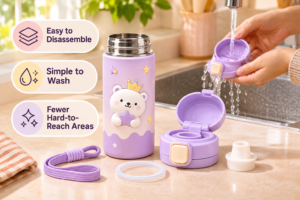
This is one point parents often realise only after buying the bottle.
A bottle that looks fantastic but has a complicated lid, narrow corners, and several tiny components can be frustrating to clean every day.
Ideally, choose a bottle with parts that are easy to remove and wash.
Check whether:
- The bottle has a wide enough opening
- The lid can be cleaned properly
- The straw or spout is removable if applicable
- The manufacturer provides cleaning instructions
- The bottle is dishwasher-safe, if that matters to you
Regular cleaning is important because leftover water, juice, or other drinks can leave behind unpleasant smells and residue.
For everyday school use, easy-to-clean kids’ water bottles are usually the more practical choice.
7. Let Your Child Pick the Design
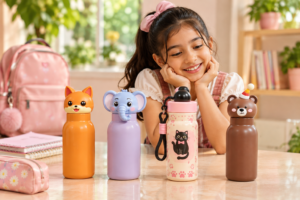
This might sound less important than the other points, but it can make a surprisingly big difference.
Kids are more likely to carry and use something they actually like.
A bottle featuring their favourite animals, colours, characters, or playful designs can make drinking water a little more exciting.
You can handle the practical checklist while letting your child choose the look.
For example:
Parent chooses:
✔ Safe material
✔ Suitable capacity
✔ Leak-proof lid
✔ Easy cleaning
✔ Comfortable size
Child chooses:
❤️ Colour
❤️ Design
❤️ Character or pattern
It’s a simple compromise, and everyone wins.
Quick Kids’ Water Bottle Buying Checklist
Before you buy, ask yourself these seven questions:
- Is the capacity suitable for my child?
- Is the bottle genuinely leak-proof?
- Is the material suitable for everyday use?
- Can my child comfortably carry it?
- Is the lid or drinking spout easy to use?
- Can I clean the bottle and lid properly?
- Does my child actually like the design?
If the answer to all seven is yes, you’re probably looking at a bottle that will work well for everyday use.
What Is the Best Water Bottle for Kids?
There isn’t one perfect bottle for every child.
The best water bottle for kids is one that matches their age, routine, drinking habits, and preferences. A younger child may need a small and lightweight bottle, while an older child might prefer a larger insulated bottle for school, sports, or travel.
Instead of choosing a bottle only because it looks cute or has a low price, look at the complete picture: safety, size, leak protection, usability, cleaning, and durability.
If you’re comparing options, take a look at the 450ml Kids Water Bottle, a cute cartoon option designed for everyday use, or the 600ml Insulated Water Bottle for Kids if your child needs a little more capacity.
Final Thoughts
A kids’ water bottle goes through a lot. It gets carried to school, thrown into bags, left on desks, taken to the playground, and occasionally dropped.
That’s why choosing the right one is worth a little extra thought.
The next time you’re shopping for a school water bottle, don’t just ask, “Does it look good?”
Ask whether it’s easy for your child to use, easy for you to clean, comfortable to carry, and secure enough to survive a busy school day.
A bottle that ticks those boxes is much more likely to become something your child actually uses every day.
Looking for a cute and practical water bottle for kids? Explore the HAULNEST 450ml Kids Water Bottle or the HAULNEST 600ml Kids Water Bottle.